Sunday, April 30, 2006

Mihos Follows Howie's Advice

Howie Carr last week:

Christy, if you really want to steal her thunder next week, just cut the price of regular unleaded gas at your convenience stores to $1.99 a gallon. Every TV camera in the state would be on the Cape.
Today's Boston Globe:
[Christy Mihos] also invited the teachers to visit his Christy's convenience store in Hyannis, where he said he personally would be pumping gas at the deeply discounted price of $1.97 per gallon.
Not sure who attracted the most cameras, but I hope Carr got his consulting fee.

Friday, April 28, 2006

Two Chances to See Dem LG Candidates

As those of you who read Blue Mass. Group already know, BlogLeft -- a loosely affiliated group of Massachusetts progressive blogs -- the Lowell Democratic City Committee (LDCC) and the Greater Lowell Area Democrats (GLAD) are co-sponsoring a Lt. Governors Forum at the Lowell Senior Center on Sunday, May 21 at 2:00 PM. The format for this event has not yet been officially finalized, but the idea is to have a debate, with all candidates answering questions asked by a moderator of some kind. All four Lieutenant Governor candidates are now confirmed to be there. The Lowell Dems have more details and David from BMG is soliciting questions. I've been told that the Senior Center has wireless Internet, so the whole event will be liveblogged. More details on that as they come available.

If you can't get up to Lowell, there will be another forum here in Watertown on Thursday, May 25th at 8:00 PM at the Brigham House, 341 Mount Auburn St, sponsored by the Watertown Democratic Town Committee. This event will not be a debate and the candidates will not be on the stage at the same time, but all four are participating. Each candidate will have a half-hour to make a statement and answer questions. Here's the schedule:

8:00Andrea Silbert
8:30Deb Goldberg
9:00Tim Murray
9:30Sam Kelley
Both events are free and open to the public. They're also both before the Democratic convention in Worcester, so they make a perfect opportunity for delegates to grill the candidates before the endorsement vote.

Thursday, April 27, 2006

Markey Amendment for Net Neutrality Fails

Yesterday, the House Commerce Committee voted on the "Communications Opportunity, Promotion and Enhancement Act of 2006" (COPE Act) which would overhaul the 1996 Telecommunications Act. Congressman Ed Markey (D-Malden) proposed an amendment to the act that would preserve Net Neutrality. You can hear Markey's statement introducing the amendment on his website. The SavetheInternet.com coalition collected a quarter million signatures in support of the Markey amendment, but it was voted down 34-22. Four Democrats voted against the Amendment, and one Republican -- Heather Wilson (R-NM) -- voted in favor.

The good news is that some of the Congressmen who voted the amendment down in subcommittee changed their votes in the full committee. We can make a difference in this fight. If you haven't called your Congressman yet, do it now.

Wednesday, April 26, 2006

Quick Question

Can somebody tell me what this elephant is supposed to be doing to the Lowell Convention Center?

On second thought, maybe I don't want to know.

Tuesday, April 25, 2006

Romney '06: Gone as Often as Here

The AP reported tonight that Governor Mitt Romney has been spent almost half his business days out of state this year. In the past months, he's been to Georgia, Washington DC, New York, Tennessee, Iowa, South Carolina, Guantanamo Bay, Cuba and countless other places I'm leaving out. From the article:

So far in 2006, Romney is spending almost half his business days outside Massachusetts, most frequently fostering his own presidential ambitions or boosting the Republican Governors Association, of which he is serving as chairman this year.

In the first four months, he was gone all or part of 56 days, including 38 during the work week. Last week, he was gone four out of five business days.
In Romney's defense, his Spokesman Eric Fehrnstrom makes the case that the Governor's travel is no different than what former Governor Mike Dukakis did during his time as chair of the Democratic Governors Association. That's as may be, but Fehrnstrom should be careful what he says if he wants to follow his boss to Washington. I can just see the Republican Primary commercials now: "Romney: No different than Dukakis". That'll win them over in South Carolina!

The Zen of Mitt

Kimberly Atkins at the Boston Herald captures this zen koan from Gov. Mitt Romney yesterday:

"You're not going to recruit candidates unless Republicans win," he said. "Candidates aren't going to run for office to throw themselves against a wall. They have to see Republicans winning. We haven't won enough elections."
Republicans can't recruit candidates for office in Massachusetts because they can't find a way to win in Massachusetts. In a related story, Romney was asked why Massachusetts keeps losing jobs: "Massachusetts is losing jobs because fewer companies are hiring people in the Commonwealth," Romney said. "In addition, Massachusetts is losing population because more people are leaving the state than settling in it. Also, 2005 MCAS scores were down because students didn't do as well on the MCAS tests," he added, helpfully.

Monday, April 24, 2006

It's the Wrong Tax

Edward Moscovitch, president of Cape Ann Economics, has an editorial in today's Boston Herald. Moscovitch echos calls for property tax relief instead of income tax cuts.

Gubernatorial candidates Kerry Healey and Tom Reilly used last week's tax deadline to renew their calls for cutting the state income tax from 5.3 percent to 5 percent - at an eventual cost of about $750 million a year. Given the uncertainties associated with the new health care bill and the cuts made in recent years to state colleges, social services and environmental programs, it's not at all clear the state could afford such a cut.

But even if there is extra money, it would be far better to cut local property taxes by raising state aid. Property taxes, after all, are not based on ability to pay, while the income tax is the fairest tax we have.

Local governments across the state are in crisis. With skyrocketing health-care premiums, local aid well below what it was four years ago and Proposition 2 overrides hard to pass, cities and towns are closing firehouses, cutting back library hours, bringing on fewer police cadets and raising class sizes.
At the end of the piece, Moscovitch asks if it's "naive to hope for a governor who levels with us about the choices we face and the true costs of cutting the state income tax?" I know at least one candidate who agrees with him.

The Fight For Net Neutrality

There's a fight brewing in Congress right now that affects all of us who provide content over the Internet and those of us who depend on that content. Telecommunications companies are trying to destroy the principle of "network neutrality" -- the idea that all network packets are created equal. The SavetheInternet.com Coalition launched their website this weekend and is making an effort to turn net neutrality from idea to law.

The concept of network neutrality is explained in this two-minute video. The concept is simple -- supporters of net neutrality want all content that's sent over the Internet treated the same. Telecom companies are against this because they want to be able to sell access to the Internet above and beyond bandwidth charges and connection fees. They want to be able to charge extra for faster service, and to be allowed to choke off their competitors' products by slowing them down to the point where they're unusable. Put another way, if telecom companies are able to pick and choose who is able to connect to what services, they will effectively own the Internet and be able to dictate who uses it and for what.

Matt Stoller over at MyDD has a great rundown this morning of the various players in the fight and the stakes we're facing.

Our own Congressman Ed Markey (D-Malden) has been out front on this issue. His amendment to the telecom bill that would codify net neutrality was voted down earlier this month. Salon also had a featured article on net neutrality last week that is worth reading, even if you have to view an ad first.

We can't let Congress give the Internet away to the telecommunications companies. It's too important to let Comcast, Verizon and AT&T dictate how we all can communicate with each other.

Update: Dan Kennedy also has a detailed post on the threat to the Internet.

Sunday, April 23, 2006

Watching the Candidates Debate

I finally got a chance to sit down and watch the Democratic gubernatorial debate that aired this morning on Channel 4. For those night owls that missed it, it will be rebroadcast tonight at midnight. All in all, I think the candidates handled themselves well, and any one of them would be an improvement over the corner office's current occupant by a country mile. I think that despite some of the contentiousness, what you saw during that debate was more agreement than disagreement. All of the candidates want to grow the economy and all think that taxes are high, though each have different plans on how to reduce them: Chris Gabrieli says wait until we've replenished the rainy day fund, Deval Patrick says restore local aid to lower the property tax, and Tom Reilly says cut the income tax ASAP. There's a case to be made for all three, though personally, it's the property tax that I'm the most concerned about.

In any case, I think Chris Gabrieli came off very well during the debate, but he did seem like a third wheel at times as Patrick and Reilly went back and forth. Gabrieli did manage to get off some good lines, and I did notice that the other candidates said "I agree with Chris" at least once each. I did bristle when Tom Reilly went off on a tangent questioning Deval Patrick's association with Ameriquest, but Patrick did a bit of political ju jitsu on the issue by discussing his role in correcting Ameriquest's predatory lending practices.

The debate had some improvements over the usual format. In the interest of time, candidates did not give an opening statement, which I think was a good move. I've never thought that opening or closing statements added much. In addition, I liked the free time for rebuttal after answering where the candidates could actually interact. Too often, the rules of the debate are so restrictive that the candidates might as well just be giving parallel speeches, and there's no opportunity for the participants to talk to each other.

Here's what I didn't like, though. The debate was taped on Friday and not aired until Sunday morning. That's fine, things are pre-taped in television all the time, but what was odd was that the press was invited to the taping, and they published articles before any member of the public had seen the debate. That meant that the Globe, CBS4, etc. could tell us what the debate was about before we were able to find out for ourselves. I would much prefer that people be able to make up their own minds about the debate without having to live in a media blackout before it's shown.

I'm in the Newspaper!

Check out the Boston Globe's profile on Blue Mass. Group in today's paper. The Globe goes through the origin story of Massachusetts' most popular progressive political blog, and also has a companion piece on one of their "differently-winged" counterparts. The highlight of the article, of course, is the sidebar listing other Massachusetts-based political blogs. Yours truly tops that list. Welcome to anyone who's stumbled upon my little slice of the Internet.

I guess that almost makes up for the Globe releasing my credit card information.

Friday, April 21, 2006

Ethics Commission Goes Too Far

Dan Kennedy has a good summary of the State Ethics Commission's recent ruling on political speech in state-owned buildings. Here's the short version of the ruling from the Globe, which Dan quotes on his blog.

[T]he commission had "tightened its rules on political activity by public officials, barring them from writing stump speeches, answering campaign questions, or holding news conferences on political topics inside the State House or other state office buildings."
The whole issue was touched off when state Democrats lodged a complaint that Gov. Mitt Romney called a press conference from the statehouse to denounce then candidate John Kerry for picking Senator John Edwards as his running mate. That seems to be a reasonable complaint, but the ethics commission has gone even further saying that if even if Romney had called a press conference for something else, and was asked about his thoughts on Kerry's pick, he would have to refrain from commenting. That's just silly.

I can understand the impulse to separate the official duties of an elected official from their campaigns. This is important to keep politicians from fundraising or doing other campaign related work on the public's dime. That said, this ruling by the ethics committee goes way beyond that, forbidding anyone from even answering questions about their campaign or holding conferences "on political topics" if they happen to be in their office. If this rule is enforced, it will have a chilling effect on speech in Massachusetts as public officials avoid even the most innocuous of questions because they're afraid someone on the other side of some issue or another will levy ethics charges against them. It's also not hard to imagine a situation where a politician uses this ruling as an excuse to duck questions being asked by a pesky reporter, claiming that they are forbidden from answering.

Unfortunately good-government types, not just here but elsewhere too, tend to err on the side of more regulation, more restrictions, when it comes to campaigns and political finance. In this case, I'm not sure that makes sense. Isn't it better for open government if politicians are able to answer any question posed to them, even if they're using state resources to do so?

Thursday, April 20, 2006

Purple Massachusetts 1998

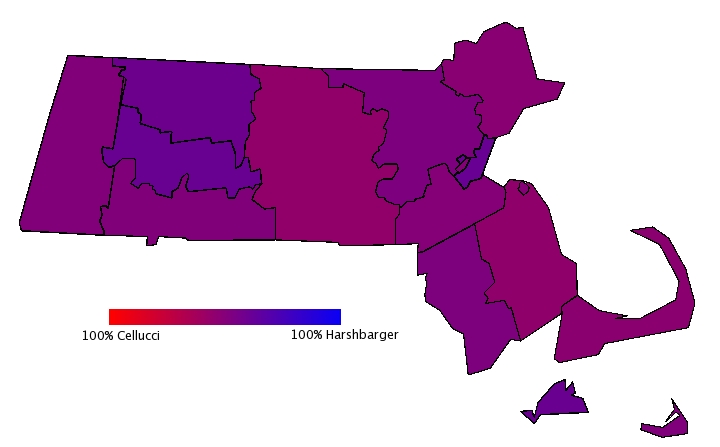
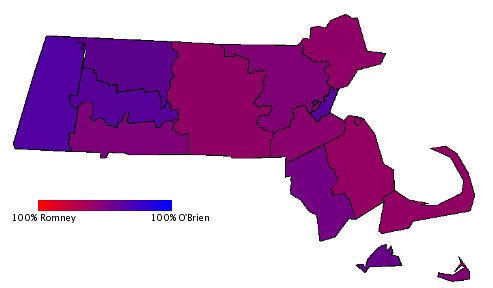
Last year, in one of my first blog posts ever, I created a map showing the results of the 2002 election by county. I colored it so that each county was a shade of purple that corresponded with the gubernatorial vote percentages in that county. A county that went for Shannon O'Brien (the Democrat) would be more blue, and a county that went for Mitt Romney (the Republican) would be more red. I had wanted to compare these results with those from 1998, but eventually I forgot about the project and moved on to other things. Over my vacation, I finally got a chance to put the map together. Here is the 1998 election map by county, in the style of the purple America map.

Harshbarger vs. Cellucci 1998
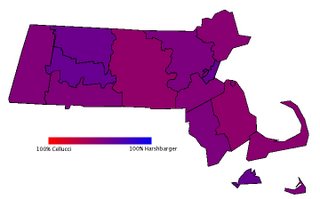


The map is a little blurry, but if you click on the full version, you can see that it looks very similar to the 2002 map except in 2002 Berkshire and Suffolk counties are noticeably bluer. Still, the differences are hard to see using this style of map. To make things clearer, I took the difference in votes from 1998 to 2002 for both the Republican candidate (Paul Cellucci in '98, Mitt Romney in '02) and the Democratic candidate (Scott Harshbarger in '98, Shannon O'Brien in '02) and put them in the following chart:

CountyGOP IncreaseDem Increase
Barnstable13.37%-1.54%
Berkshire-32.80%37.62%
Bristol2.86%16.02%
Dukes6.67%3.89%
Essex19.73%1.35%
Franklin-5.07%12.22%
Hampden12.98%13.93%
Hampshire-4.58%20.10%
Middlesex16.34%4.15%
Nantucket12.48%3.87%
Norfolk16.33%2.99%
Plymouth23.42%10.84%
Suffolk3.83%26.77%
Worcester11.40%9.37%
Total12.91%9.33%
What this shows is that O'Brien got more votes than Harshbarger in every county except Barnstable. Romney did much worse than Cellucci did in Berkshire County, and lagged behind in Franklin and Hampshire counties as well. This data would suggest that while O'Brien did make gains on Harshbarger's run in 1998, she could not keep up with Republican gains in places like Middlesex, Essex, Norfolk and Worcester counties.

How much of the increase in turn out can be explained by increased partisan voter registration during that time? By way of comparison, the number of registered Republicans increased by 9.17% from 1998 to 2002 while the number of registered Democrats increased by only 3.94%. That's a little misleading because there are so many more registered Democrats in Massachusetts than Republicans. Despite the difference in percentage gain, the Democrats actually registered over 10,000 more people than the GOP in those four years. That said, both parties increased their vote totals by more than increased voter registration explains.

What can we take away from this? First is that, though Shannon O'Brien's percentage of the vote was lower than Scott Harshbarger's, she actually did better than he did in terms of vote totals. In fact, O'Brien actually would have beaten Paul Cellucci if you match her numbers from 2002 with his from 1998. That makes sense given the Democrats' higher turnout in '02, but you can really see how the increased Republican turnout effected the race. A greater percentage of Republicans turned out in 2002 than in 1998, and the Republican precentage change reflects that. The Dems are on the right track this year with their Victory 06 campaign. The winner in 2006 won't be the one who switches the most votes from the other party, but the one who's able to grow their vote total by bringing in people who are not regular voters.

Globe: Ignore Our Reporting

On today's editorial page, the Boston Globe editors caution voters not to judge candidates by their bank accounts. Here's the beginning of the editorial:

One plot summary for the 2006 gubernatorial campaign is that it's a race pitting Attorney General Tom Reilly against the millionaires: Chris Gabrieli, Lieutenant Governor Kerry Healey, Christy Mihos, and Deval Patrick. The underlying theme is that the politician standing closest to poverty is the purest. And since Reilly is the only one who rents his home, sends his children to public schools, and lives on a government salary (Healey returns hers to the state), he must be the one who can best sympathize with the little guy.

It's appealing. But voters need to know more. The size of a candidate's bank account can reveal useful information. But measuring a candidate with a calculator can also generate stereotypes that obscure key issues.
I find this very ironic coming from the paper that ran a whole story on Deval Patrick's house, followed it up with a story on how every candidate but Tom Reilly lives in a swanky pad, complains that the "millionaires" won't release their tax returns, and tells us exactly how many of them send their kids to expensive private schools. Now they're cautioning us that voters should be looking for a fuller picture of the candidates? The Globe has been the primary source of the "plot summary" of Tom Reilly vs. the Millionaires, and it seems to me that it's disingenuous for them to now tell us on the editorial page that none of that really matters while their news pages continue to frame the election that way.

Wednesday, April 19, 2006

Who Raised More From Out of State?

Letter writer Dan Clawson from Northampton corrects the Globe's assertion that Deval Patrick has raised the most out-of-state money in the campaign so far, using the Globe's own numbers:

A little math, combined with your own graphic, shows that out-of-state contributors have given Thomas Reilly $630,000 and Deval Patrick $561,000.
While it's true that a greater percentage of Patrick's funds have come from beyond Massachusetts' borders, in terms of actual dollar amounts, it seems that Tom Reilly has actually raised more from out of state. To be sure, I don't think that out-of-state money really matters. It is, unfortunately, often used as a scare tactic or to indicate that the recipient of those funds has no local support, or would be beholden to nebulous far away interests. Neither of these things are true for either Tom Reilly or Deval Patrick, and it would be nice if the Globe spent more time writing about what the candidates want to do once in office than how they plan to win.